
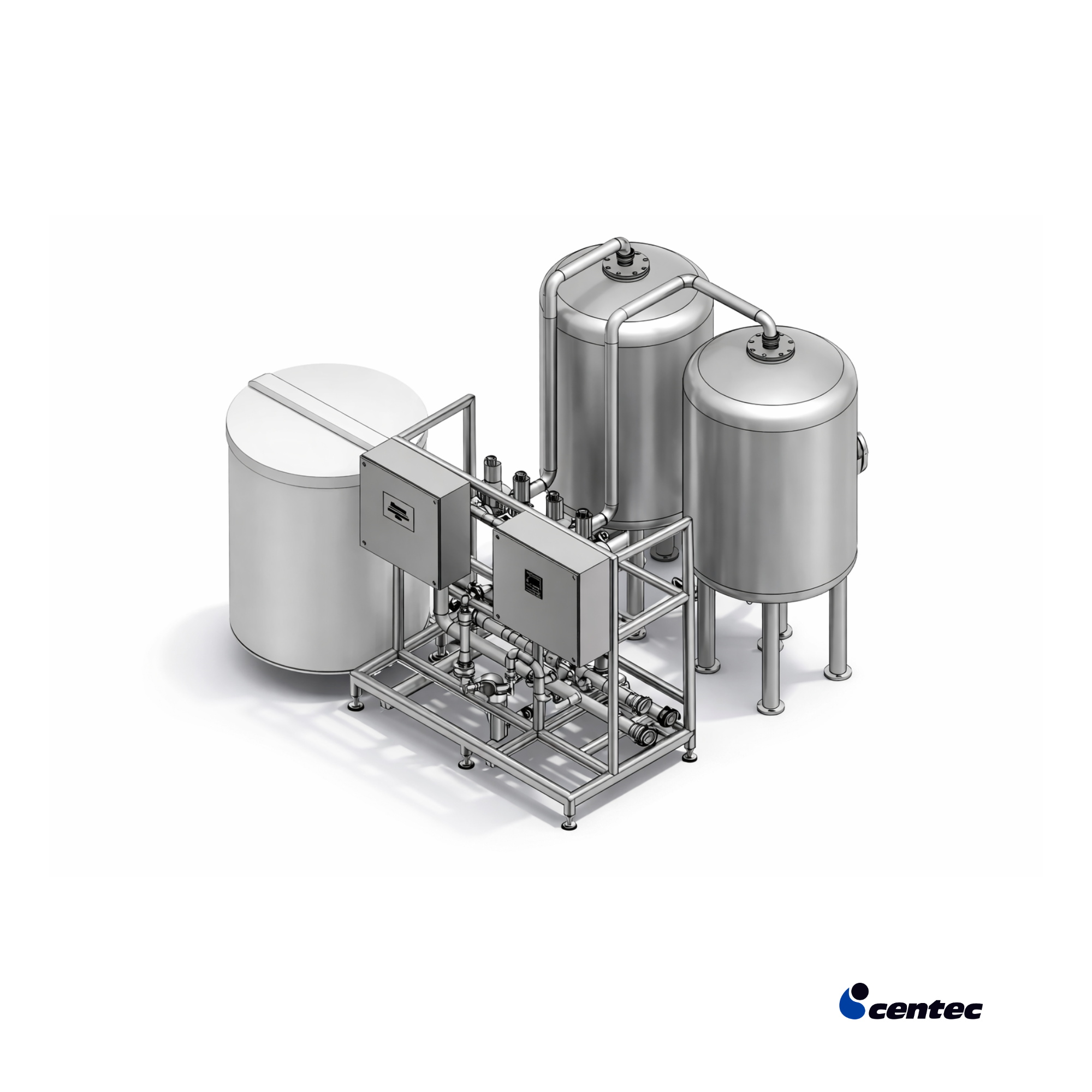
IONTEC - Water Softening & Demineralization
IONTEC is an ion exchange system for water treatment, used for applications such as heating, cooling, and cleaning. Water hardness can cause limescale deposits in piping systems and process plants – IONTEC reduces this hardness through ion exchange .


 Application
 The IONTEC ion exchange system softens water used for purposes such as heating, cooling, and cleaning. Hard water causes limescale deposits in piping systems and process plants.


 How does ion exchange work?
 The system contains ion exchange resins :
- Insoluble, granular polymers – suitable for the respective application
- The resin contains positively ( cations ) or negatively ( anions ) bound ions.
- These ions are exchanged for ions from the water as the water flows through the system.
Water softening (cation resin with Na⁺)
A cation resin containing Na+ is used for water softening:
- Ca²⁺ and Mg²⁺ ions (hardness-causing minerals) are exchanged for Na+ ions from the resin.
- When the resin is "exhausted", a regeneration cycle is started.
- Regeneration is carried out with brine , during which Ca²⁺ and Mg²⁺ are removed from the resin.
Demineralization (removal of dissolved ions)
Demineralization essentially involves removing all dissolved ions from the water:
- Water flows through a cation resin with H+ (exchange of all cations)
- then an anion resin with OH- (exchange of all anions)
- H+ and OH- combine to form pure water.
Regeneration:
- Cation resin: Regeneration with acid
- Anion resin: Regeneration with strong alkali. Resin type (depending on the version):
- in separate containers
- or together in one container ( mixed bed design ; on request)
Typical role in the water treatment concept
Ion exchange systems are often used as the first step in a more complex water treatment system.
Highlights
- Standard version entirely in stainless steel
- Mixed-bed design available on request for water demineralization
- Customized modular design with standard PLC
- Frame-mounted for easy installation and commissioning
- Hygienic design and full CIP/SIP capability
- In accordance with applicable guidelines (e.g. cGMP , FDA , GAMP , ISPE )
- Fully qualified (DQ, IQ, OQ) if desired
Technical data
Capacity: 1 – 300 m³/h
Material: as required (plastic, stainless steel)
Options (depending on the version / project-specific)
- different levels of automation
- Duplex operation
- Remote maintenance access
- Hardness measurement
- Prefiltration
- CIP cleaning
contact
For project-specific design and integration, please use the contact form below.
Modular design & extensions
FILTEC AC – Activated Carbon Filtration
Water pretreatment – removal of suspended solids & bacteria
Chlorine dosing for process and product water